

Silvertone was the “musical” brand for the Sears, Roebuck & Company, beginning nearly a century ago. The big boom was ukuleles in the ’teens and twenties. The first Silvertone product was a hand-cranked phonograph introduced in 1915.

As early as 1905, Sears, Roebuck & Company was selling musical instruments – mainly ukuleles – built by the Harmony Company. In 1916, Harmony was bought by Sears, continuing to make instruments for Sears and other customers. In 1940, Sears sold the Harmony brand to an investment group and adopted the Silvertone brand name for all musical instruments By then, Sears was buying instruments from many other U.S. builders as well as Harmony.
The country was still very rural prior to World War II with the population spread out over wide areas. The big “catalog houses” such as Sears, Montgomery Ward and Spiegel served customers around the country from their big city headquarters. These companies sold nearly everything that you needed, and some would even ship you the house to put it all in.

The 1940s market the introduction of Silvertone electric guitars. The late ’30s had seen plenty of ‘Hawaiian’ lap steel instruments and amps, but 1941 marked the first year you could get an electric six-string in the Sears catalog. The selections were limited, but the funky, eclectic styling and easy affordability made them popular with players.

Silvertone guitars were inexpensive and readily available by mail order. Struggling blues musicians of the 1940s found them roadworthy and replaceable, with legends such as Muddy Waters and Arthur “Big Boy” Crudup among those who chose Silvertones.
Changes were coming fast and furious in the post-war period. Musical tastes were changing, the suburbs were exploding and there was a cultural energy waiting to be unleashed.
The electric guitar went solid in the 1950s, and Silvertone was right there at the beginning.
This is the decade where Silvertone electric guitars began to hit their stride. The first solid bodies appeared in 1954 and their immediate success was followed up with additional models. More than 25 solid, hollow, and hybrid guitars were introduced, many of them Silvertone classics.

Blues and country music were American art forms that moved across the country as people migrated west, north and in every other direction. Servicemen returning from World War II brought folk styles back from Europe and jazz was approaching its heyday.
The 1950s was a great decade to be a guitar player. Along with new music styles, new guitar ideas were coming from inventors, tinkerers and technicians. Recording technology was improving, popular music was expanding and everybody wanted to party.
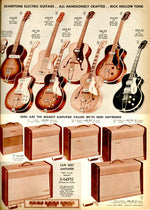
The guitar folks at Sears were well aware of the trend and the line of Silvertone electric guitars expanded greatly in the ’50s. The watershed event being the introduction of the first Silvertone solid body electric in 1954. The first solid bodies were the 1361 and 1363 models that made a brief appearance in the Spring/Summer 1954 catalog. In the fall of ’54, Dan electro, the company that made Silvertone amplifiers for several years, began their long run of Silvertone models. The 1375 (single pickup) and 1377 (two pickups) models first appeared with a solid poplar, single-cutaway “peanut” body. A year later, the famous “lipstick” pickups made their debut. By 1958, the peanut body had gained 2” in width and the highly popular 1303/U2 models were introduced.
Single-pickup models had the pickup mounted in the neck position, rather than in the bridge position that we’d expect today. Guitar tone back then was darker and rounder than we think of it today, and solid body guitars were aiming for the mellow tone of a full-size jazz guitar. But by the end of the ’50s, guitarists were beginning to consider the solid body guitar as its own animal – the boundaries of guitar sound were expanding.
Just about every musical icons of the ’60s played their first notes on Silvertone guitars in the 1950s. Jimi Hendrix named his 1956 Silvertone “Betty Jean,” after his girlfriend. Bob Dylan rocked a 1319 in 1958. At least one 1950s-era Silvertone can be heard on Dylan’s 2006 release, “Modern Times.”
Over 100 biographies of modern musicians mention Silvertone and the first guitar brand of well-known musicians. And why not – they were affordable, reliable and available to anyone with a Sears catalog (which was just about everyone at the time).
As the decade came to a close, music was getting ready for major changes and disruptions. New sounds were happening and even the way that music was written, recorded and sold was changing. The big factor – baby boom kids were just entering their teens and looking to break out of the norms. Times were a-changing.
The 1960s were the Golden Age for guitars in America. The folk music boom was followed closely by the British Invasion and the demand for guitars skyrocketed as young people by the millions started making their own music. The Silvertone Amp-In-Case model 1457 was the entry point for thousands of them.

The 1960s were a decade of change in just about every facet of American life. Early in the decade, there was a great new interest in folk music as folk artists moved from rural areas to the cities. Pete Seeger, Dave Van Ronk, Joan Baez and Bob Dylan began to get notice, and as they grew in popularity, many young people picked up guitars to join them. Like today, high-end guitars were expensive and upscale makers just couldn’t keep up with the demand for acoustic guitars.
Country, blues and rockabilly also gained in popularity, driving up demand for electric guitars. Overnite, there was a skyrocketing demand for both acoustic and electric guitars and Silvertone had access to a handful of manufacturers who could supply significant quantities. Once the British Invasion hit full stride in the mid’60s there weren’t enough guitars to go around

In 1959, Joe Fisher became the principal musical instrument buyer for Sears. He stayed in the position until 1968 and eventually became a vice president of the company. He had a big impact on how the Silvertone line developed in the ’60s. He could see the demand for guitars growing and he worked with his guitar suppliers to develop instruments with features that young players wanted at prices they could afford. It was through his effort that Silvertone emerged as the leading brand for garage band guitarists. In the mid-’60s a Fender Strat sold new for around $300. A good starter Silvertone could be had for around $80. The math made sense to thousands of players.
During the ’60s, Silvertone tapped many of America’s guitar makers. Names like Harmony, Kay, Danelectro, Supro, Valco and National all made guitars under the Silvertone name. Some of these were nearly identical to those that wore the maker’s name and others were developed specifically for Silvertone. For a great peek at the classic guitars from the period, check out silvertoneworld.com and vintagesilvertones.com. Both are great resources for Silvertones of days gone by.

Fast Forward
The demand for vintage guitars of the 1950s and ’60s soared of over the past few decades and prices for exclusive vintage axes can top $100,000. Recently there’s been great interest in Silvertone guitars from the era with many models that originally sold for under $100 now demanding prices over $1,000. That’s where we come in.
Silvertone Reissue models have all the vibe and tone of the original vintage models, but with upgraded features – better bridges, machine heads and neck joints — that make them true professional instruments for the 2000s. And you can buy a new Silvertone Reissue model for about the same price – in 1960 dollars adjusted to 2013 dollars – as the original.